
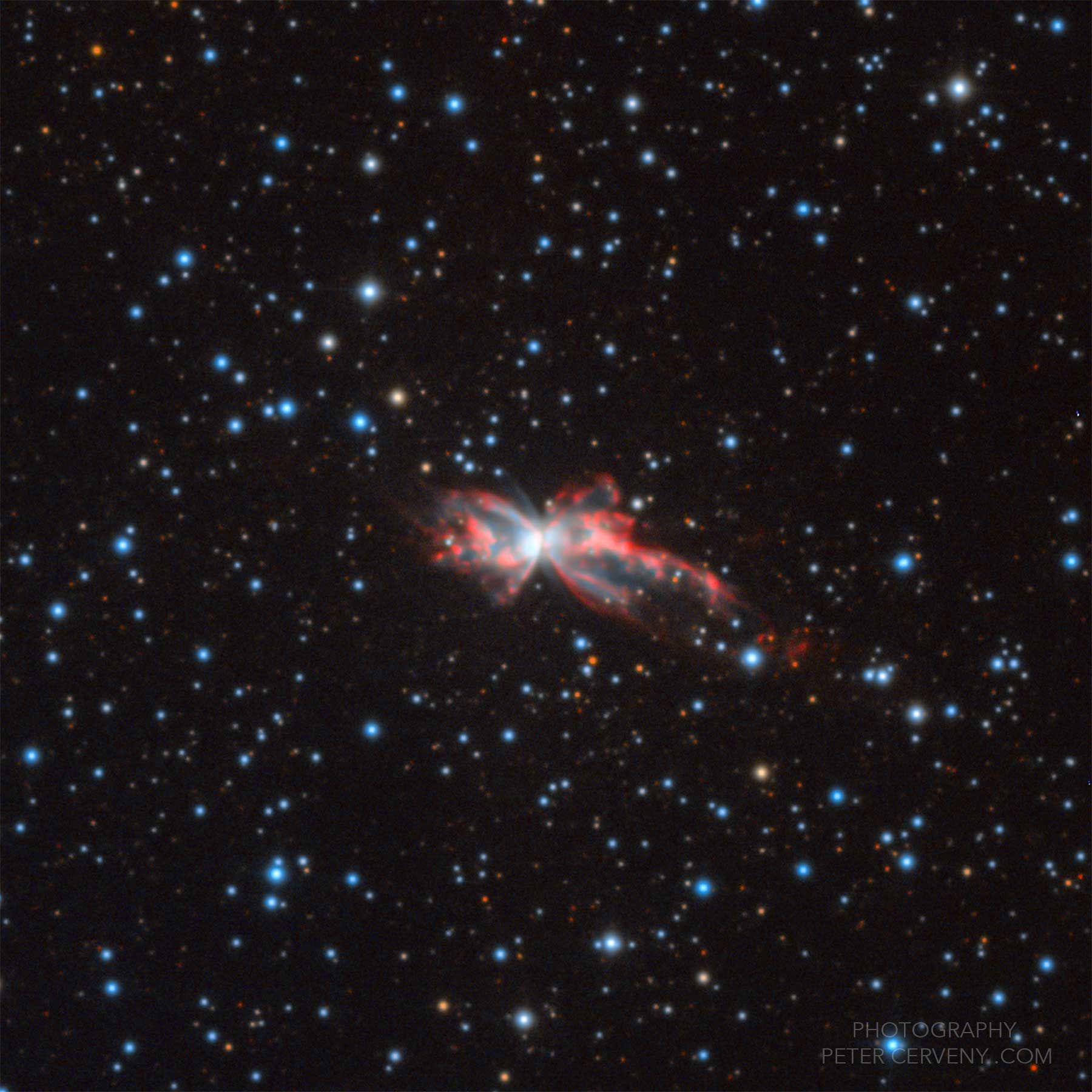
NGC 6302 (also known as the Bug Nebula, Butterfly Nebula, or Caldwell 69) is a bipolar type planetary nebula in the constellation Scorpius. The structure in this planetary nebula is among the most complex ever seen in any planetary nebulae. The spectrum of Butterfly Nebula shows that its central star is one of the hottest stars known, with a surface temperature in excess of 250,000 degrees Celsius. This implies that the star from which it formed must have been very large in order to become this hot.
The central star, a white dwarf, was identified in 2009, using the upgraded Wide Field Camera 3 on board the Hubble Space Telescope. The star has a current mass of around 0.64 solar masses. The star is surrounded by a dense equatorial disc composed of gas and dust. This dense disc is postulated to have caused the star's outflows to form the bipolar structure seen in the Nebula. similar to an hourglass. This bipolar structure shows features such as ionization walls, knots and sharp edges to the lobes.
| Object | NGC6302 Butterfly Nebula |
| Constellation: | Scorpius |
| Position: | RA 17h 13m 44.5s Dec -37° 06' 11'' |
| Apparent Size: | 3.0 arcmins |
| Apparent Magnitude: | 7.1 |
| Distance in light years: | 3400 ± 500 ly |
| Photo Data | |
| Date: | 10 Aug 2024 - 07 Sept 2024 |
| Location: |
El Sauce Observatory Chile (1525m ASL) GPS: 30.472529° S, 70.762999° W |
| Telescope: | CHI-1-CMOS: Planewave CDK24 610 mm, f/d 6.5/3962mm |
| Camera: | QHY 600M Pro, 3.76μm, 9576 x 6382px, Bin-2 4788x3191px, @ T sensor = -10°C |
| Field of View: | 31x21 arcmins |
| Pixel Scale/Resolution: | 0.39 arcsec/px |
| Expose frames/times: | R 24x180s, G 5x180s, B 5x180s, H 51x300 |
| Total expose: | 5h 57min |
| Filter: | Astrodon Red, Green, Blue, Ha (3nm) |
| Mount: | Mathis MI-1000/1250 with absolute encoders |
| Software: | Siril 1.4, Photoshop CC |
| Remarks: |
© Photos and photo data by Peter Cerveny
© Object description/intro text fully or partially by Wikipedia,
which is released under the Creative Commons Attribution-ShareAlike 4.0 International License